


Can We Really Fix Wet Spots With Tillage? If So, Why Are They Still There?
Updated: Apr 8
By Buz Kloot
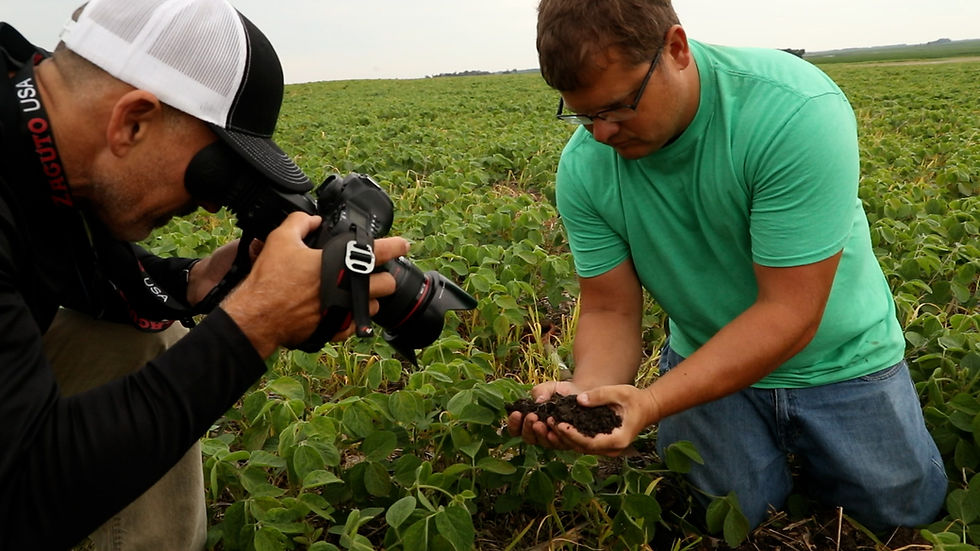
Back in July, 2016, Joe Dickie and I were standing on one of Jesse Hall’s fields in eastern Kingsbury County, trading the usual insults — he was picking on my hat, and I was picking on his camera angles — Jesse cut through the noise with a line that stopped us both:
“We tried fixing wet spots with tillage for years. It never worked.”
If you’ve ever fought those stubborn low areas — the ones that stay soggy no matter how many times you chisel, disk, or rotary hoe them — you know the feeling. The conventional wisdom says:
“Open it up. Dry it out. Work it black.”
But Jesse’s story doesn’t follow the old script.
For decades, he and his dad did exactly what most of us were taught. They plowed every low spot, field-cultivated in the spring, and hoped for a miracle. It never came. The wet spots stayed wet. The crop drowned. And the weeds loved every minute of it. Then Jesse added something that, on paper, shouldn’t sound rebellious — but kind of is: a small grain.
When he shifted to a three-way rotation with oats, his infiltration rates increased, his soil structure changed, and — almost unbelievably — most of those long-troublesome wet spots began to disappear, not from horsepower, but from biology. Meanwhile, Joe and I exchanged that familiar look — the one we’ve shared with several South Dakota producers this year — because once again someone was demonstrating a truth that runs against conventional wisdom:
You don’t fix water problems with tillage; you fix them with biology.
Jesse and his friend Jim added the next layer: livestock integration. Ten heifers. Five goats. A handful of polywire. And the kind of neighborly skepticism that turns into bragging rights once the grass comes back thicker. The goats — God bless them — "slicked up" everything the cattle didn’t want, including bull thistles stripped clean to a stick. Jesse laughed, telling that story. The man loves data, but he also loves a good thistle-eating goat.
And here’s the real call to action Jesse wanted other farmers to hear:
“Don’t be afraid to try something new. But if you experiment, do it right — and start small.”
You don’t need to switch the whole farm to no-till next spring. You don’t need to buy a herd of cattle. You don’t even need to own livestock — your neighbor might be glad to run theirs on your cover crop. But you do need to take one field, add one small grain, plant one cover crop, and give the biology a chance to work. The worst that happens? You learn something. The best that happens? The wet spots finally tell the truth — and they start to go away.
So the real question is:
If tillage fixed wet spots, why are they still there?
Maybe it’s time — field by field, season by season — to see what biology can do that iron can’t.
Visit these “Growing Resilience Through Our Soils” information pages:
1. Podcast page for drought planning fact sheets, Q&As, news, podcasts, and more.
2. Video page to watch videos of other ranchers’ journeys toward improved rangeland/pasture.
3. Follow Growing Resilience on social media:
4. Our homepage: www.growingresiliencesd.com


Comments